
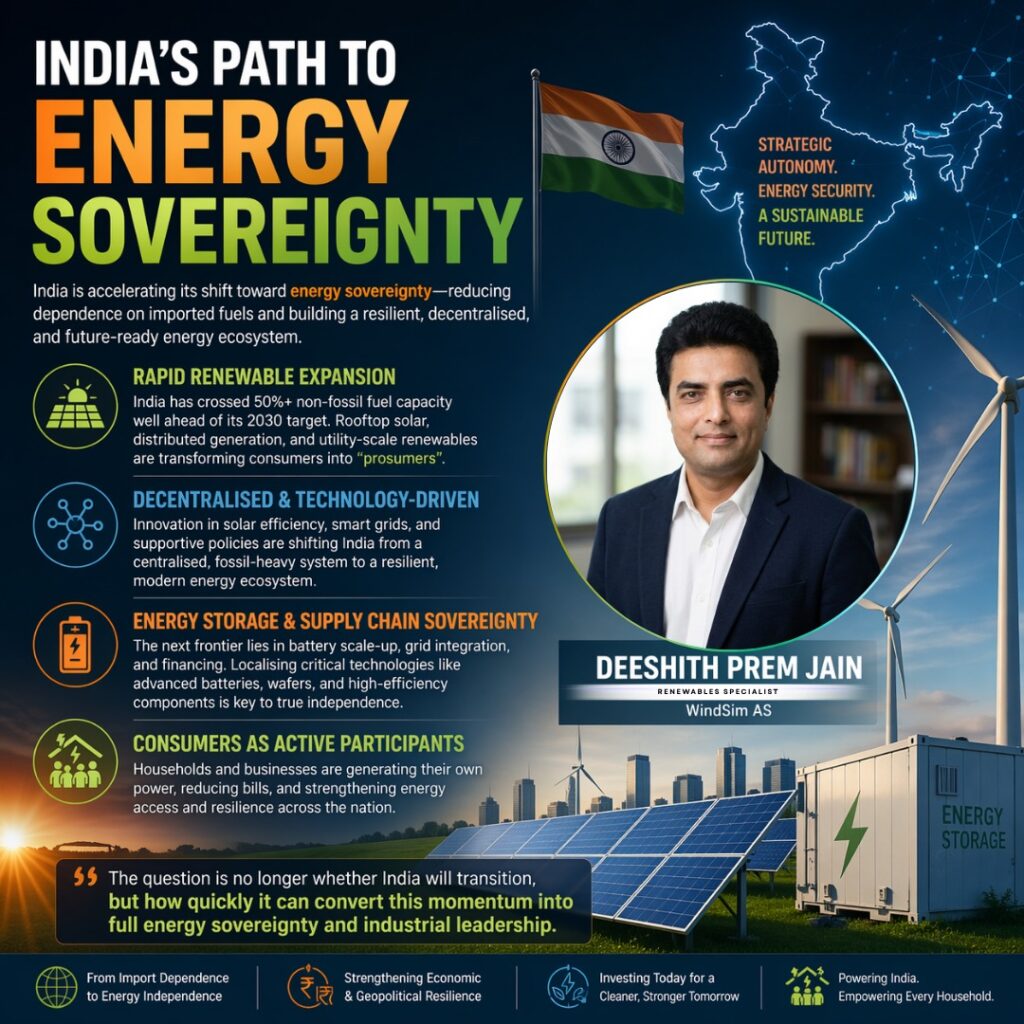
Deeshith Prem Jain, Renewable Energy Specialist at WindSim AS, shared his perspective on India’s accelerating shift toward Energy Sovereignty, a transformation that is reshaping not just the power sector, but the country’s geopolitical and economic resilience.
Here’s what he had to say:
India’s Energy Sovereignty Revolution
For the Indian consumer, the monthly electricity bill has long felt like an unavoidable tax on existence—a recurring fiscal burden that escalates alongside rising temperatures. Yet, beneath this micro-level strain, a massive structural pivot is underway. While global observers expected a slow retreat from coal, India has delivered a masterclass in energy indigenization. In June 2025, the nation hit its 2030 non-fossil fuel capacity target a full five years ahead of schedule. This is no mere administrative victory; it is a decisive move to decouple the national economy from the volatility of global fuel markets. By shifting generation from centralized, fossil-heavy plants to millions of rooftops, India is not just changing how it produces power—it is rewriting the geopolitical terms of its own growth.
The modern global economy is currently navigating a state of “perpetual crisis.” For a nation like India, which imports over 85% of its crude oil, the ticking clock in the Strait of Hormuz, through which 45% of those imports historically transited is a constant threat to fiscal stability. To appreciate the stakes: a mere $10 per barrel increase in global oil prices expands India’s import bill by approximately $14 billion to $16 billion.
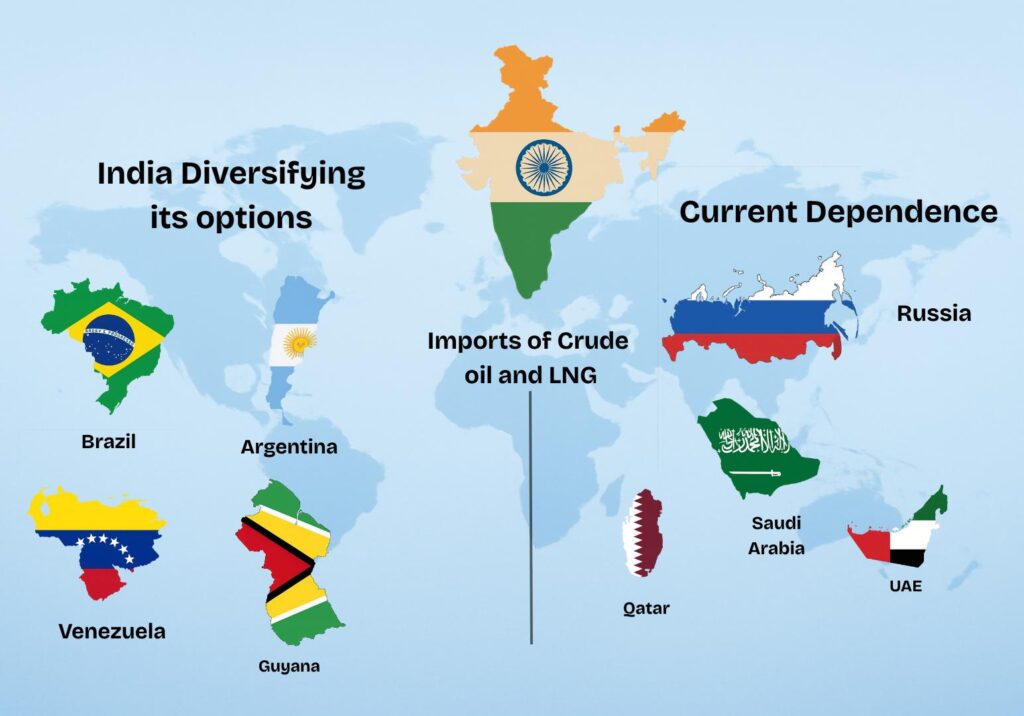
In March 2026, the pivot toward “Energy Sovereignty” is no longer a climate-driven obligation; it is a geopolitical necessity. The PM Surya Ghar Muft Bijli Yojana serves as a strategic “natural hedge,” a silicon-based shield designed to decouple domestic growth from global energy blackmail. By converting millions of rooftops into power plants, India is transforming itself from a vulnerable “buyer” of energy into a resilient “builder” of sovereign infrastructure.
The velocity of India’s transition has blindsided global analysts. While the nation famously struggled with its “175 GW by 2022” target in previous years, the acceleration since 2024 has been historic. In June 2025, India reached its milestone of 50% installed electricity capacity from non-fossil fuel sources. As of January 2026, that figure has climbed to 52.3%.
Effectively, India has fulfilled its Nationally Determined Contribution (NDC) target for 2030 a full five years ahead of schedule. This isn’t just about domestic lighting; it’s about fueling a digital sovereign cloud. As data centers and AI emerge as massive drivers of electricity demand, renewable energy is the only scalable fuel source that can keep pace without exploding the national trade deficit.
“Over the next twenty years, India is on track to see the single largest increase in energy demand of any country worldwide… [it] is expected to be the largest driver of global energy demand through 2035.” — (Source – International Energy Agency (IEA))
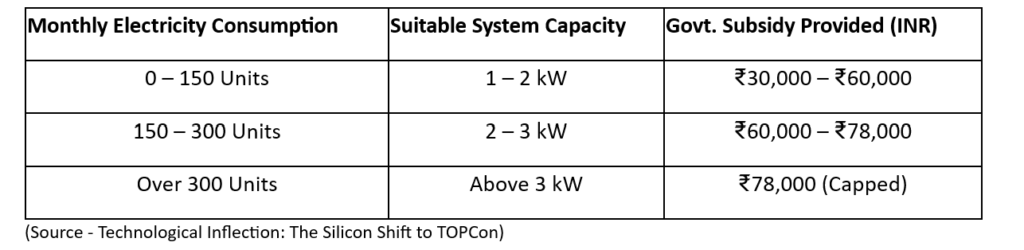
For the Indian homeowner, the solar revolution is felt most tangibly in the monthly budget. Current data indicates that 45% of participating households in the rooftop scheme have already achieved “zero electricity bills.” This is primarily driven by 3 kW systems that generate over 300 units per month, perfectly offsetting the free electricity provision.
Regional competition is adding flavour to the rollout: Lucknow has recently overtaken Surat as the leading district for rooftop solar, boasting over 87,000 installations as of April 2026. The government is on track to reach the milestone of one crore (10 million) households by the 2026-27 target date.
The graded subsidy structure is designed to maximize utility for different consumption tiers:
We are witnessing the silicon equivalent of the shift from internal combustion to solid-state. India is no longer just deploying legacy tech; it is leapfrogging toward high-efficiency chemistry. The industry has seen a rapid move from Passivated Emitter and Rear Cell (PERC) technology to N-type Tunnel Oxide Passivated Contact (TOPCon) cells, which now account for 60% of mainstream production.
For the homeowner, this matters because N-type wafers (holding a 70% market share) offer significantly higher efficiency and lower degradation over time, ensuring the roof produces maximum value for 25 years. To protect this transition, the government is enforcing “Value Chain Sovereignty” via the Approved List of Models and Manufacturers (ALMM). ALMM List-II mandates the use of domestic cells starting June 1, 2026, while ALMM List-III will mandate domestic wafers by 2028.
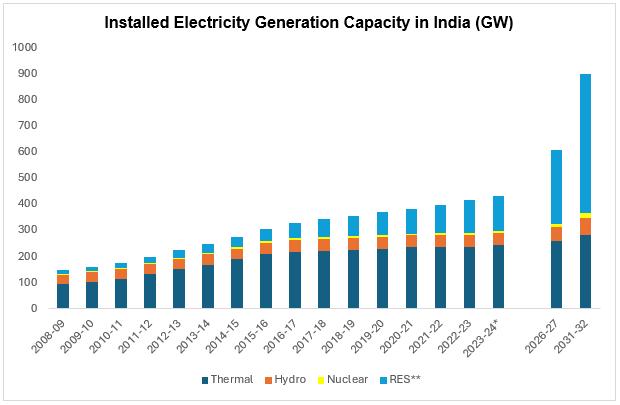
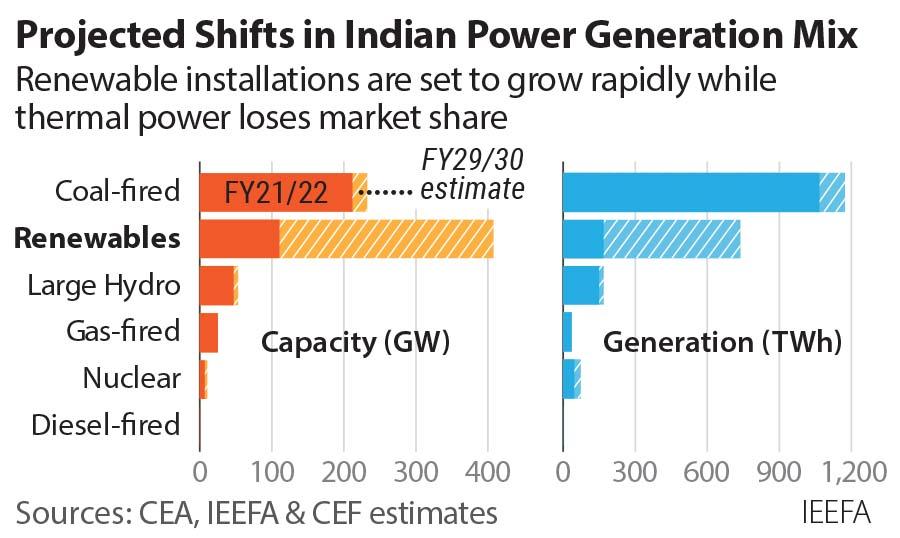
India’s “Panchamrit” pledge, once dismissed as overly ambitious, has transitioned into a documented reality. As of January 2026, non-fossil energy sources reached a staggering 52.3% of the country’s total installed power capacity of 520.5 GW. Of this, 271.96 GW is now derived from non-fossil sources, including renewables and nuclear.
While coal remains the “shock absorber” of actual generation—providing roughly 70% of the units consumed—the capacity mix has fundamentally shifted. This acceleration was catalysed by aggressive policy de-risking and a technological inflection point: solar tariffs have plummeted nearly 80% over the last decade. Solar now stands as the primary driver of this transition, with its capacity reaching approximately 2.5 times that of wind.
“India is set to play a central role in the global clean energy transition in the next decade… the country’s energy policy choices will have an outsized influence on global emissions trajectories in the coming decades.”
The current landscape is defined by three pillars:
• Utility-scale: Massive ground-mounted parks (approx. 110.43 GW).
• Rooftop Solar: Decentralized residential and commercial power (approx. 25.73 GW).
• PM-KUSUM & Off-grid: Solarizing the agricultural heartland (approx. 14.10 GW).
However, a strategist must acknowledge the hurdles. While deployment is booming, technology ownership remains a steeper climb. The Advanced Chemistry Cell (ACC) PLI scheme, critical for battery storage, has seen “sluggish” progress. As of late 2025, only 1.4 GWh—or roughly 2.8%—of the targeted 50 GWh capacity had been commissioned. This delay is largely attributed to technical complexity and visa delays for the foreign experts needed to calibrate high-precision manufacturing lines.
Furthermore, the grid is feeling the strain of intermittent power. Emerging issues include:
• Transmission Margins: Nearly 4 GW of commissioned capacity in Rajasthan and Gujarat is facing curtailment during peak hours due to inadequate grid headroom.
• Policy Conflict: In several states, the provision of “free electricity” through populist policies is diminishing the incentive for households to invest in rooftop solar.
• Financing Gaps: While demand is soaring, the bottleneck remains in capital access; only 1.28 lakh loans have been disbursed against a much higher volume of applications.
The engine room of this revolution is a historic redirection of capital. Over the last decade, the ratio of investment in fossil fuels versus non-fossil capacity has flipped from 1:1 to 1:4. Clean energy is no longer a speculative venture; it is the “safe bet” for private equity and institutional investors.
A critical component of this de-risking is the involvement of Development Finance Institutions (DFIs). For example, the World Bank has provided $3 billion in support specifically for India’s Green Hydrogen ambitions, while Sovereign Green Bonds (totalling ₹477 billion) have set price benchmarks that deepen the domestic investor base. Furthermore, the introduction of the Unified Pipeline Tariff (UPT) has standardized gas transportation costs under a “One Nation, One Grid, One Tariff” model, improving the affordability of natural gas as a bridge fuel.
Investment is the fuel, but industrial modernization is the vehicle. This transition is projected to create 17 lakh (1.7 million) direct jobs across manufacturing, logistics, and maintenance. However, “energy sovereignty” requires more than just local labour; it requires the “Make in India” indigenization of the entire value chain.
The government has given this mandate “teeth” through the Approved List of Models and Manufacturers (ALMM). To ensure the decoupling from global supply chains, ALMM List-II (requiring domestic solar cells) becomes effective in June 2026, while ALMM List-III (targeting wafers and ingots) was introduced in March 2026. Solar module manufacturing capacity has already surged to 172 GW, but the strategic focus is now shifting upstream to eliminate the “upstream gap” in polysilicon and wafers.
“Every solar installation under PMSGMBY offsets carbon emissions equal to planting 100 trees.”
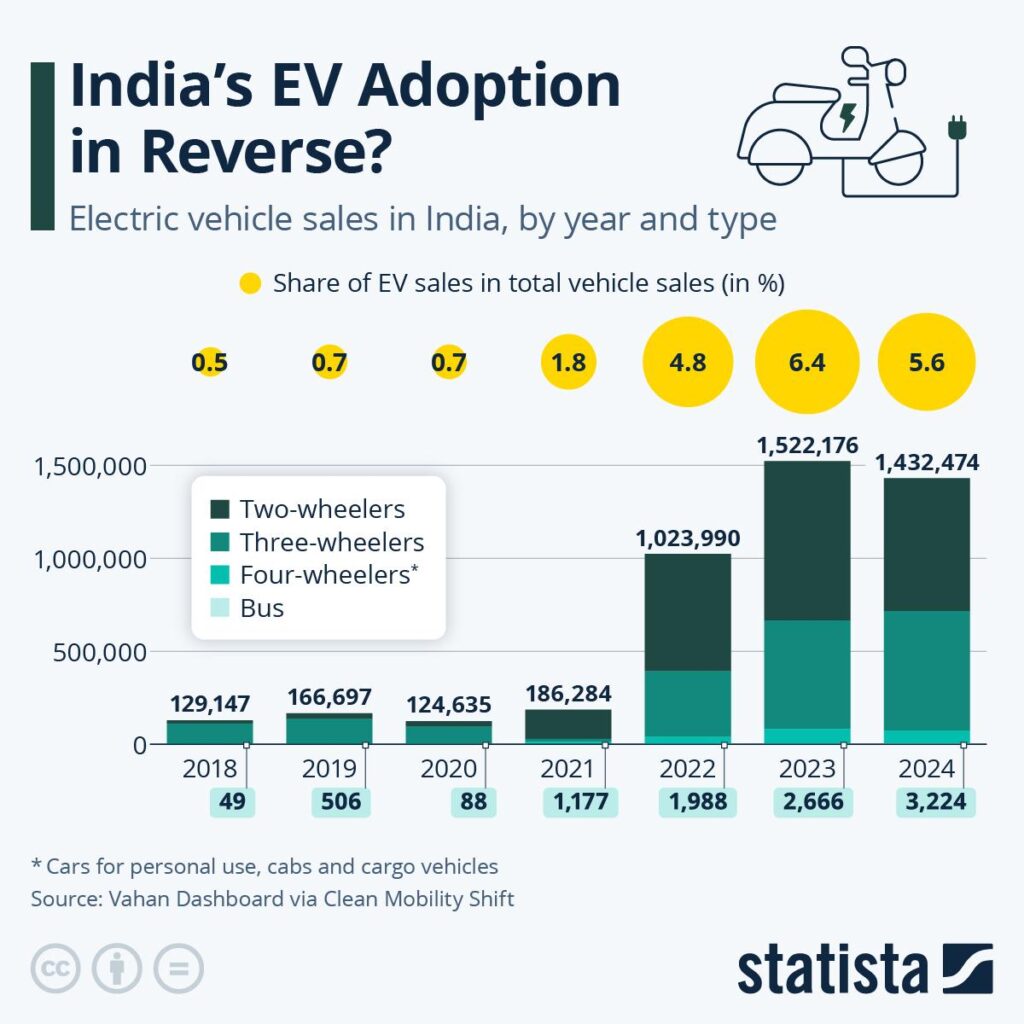
The solar surge is creating a self-sustaining clean energy ecosystem by driving EV adoption, which reached 2 million units in 2025. Policy designers are increasingly using “Fear of Missing Out” (FOMO) mechanisms to accelerate this transition. For instance, the Delhi EV Policy 2026-2030 features tapering incentives that decrease annually, pressuring consumers to act. Most significantly, Delhi has mandated that registrations for internal combustion three-wheelers will end in January 2027.
Solar “prosumers” are becoming the primary drivers of this infrastructure. By generating fuel on their own rooftops, they are creating a decentralized charging network that eases the burden on the national grid and effectively internalizes the energy value chain.
CONCLUSION:
Despite these landmark achievements, a cold reality check is necessary for the final stretch toward 2030. The urgency of this transition is underscored by geopolitical disruptions in chokepoints like the Strait of Hormuz, which can double crude costs overnight. Yet, India’s “storage gap” remains a bottleneck. While the target for battery manufacturing is 50 GWh, the Advanced Chemistry Cell (ACC) PLI scheme has seen only 2.8% progress—with just 1.4 GWh commissioned.
As India moves from deploying technology to owning the manufacturing of N-type TOPCon cells and battery chemicals, we must ask: Is technology ownership the final hurdle required for India to transform from a massive market into the world’s undisputed energy leader, or will the “upstream gap” in raw materials remain our Achilles’ heel?
India’s path forward is defined by radical localization. The next frontier is the Model Solar Village initiative, which aims to establish one energy-self-reliant village in every district. Each selected village receives a ₹1 crore grant to set a benchmark for distributed renewable energy.
As we move toward a future where power is decentralized and domestic, your home becomes more than a residence-it becomes a strategic asset in the nation’s energy security. In a world of volatile oil prices and shifting borders, is your rooftop the most valuable piece of real estate you own?